Sunday, November 12, 2017

Weekly blog 11/12/17

Image: 


Summary: This week we learned about classification. Classification is when you put something in a specific category. An example is when you put dogs and cats as mammals and when you but salmon and trout as fish. I also learned about different types of classifications such as eukaryotes. Eukaryotes is an organism that has cells that has a cell nucleus. An organism has to have certain traits about itself to be in a specific classification. Like tetrapods which is an organism that has 4 legs and movable joints. A dog would be classified as a tetrapod.

SP7: Engaging in argument from evidence
In science, reasoning and argument are essential for clarifying strengths and weaknesses of a line of evidence and for identifying the best explanation for a natural phenomenon.

Did you participate in a class discussion providing evidence for your answers, and/or used the ACE strategy in your work?

Yes this week we did a google doc about classification and we needed to answer questions using a different number of sources.

Friday, November 3, 2017

Weekly blog 11/3/17

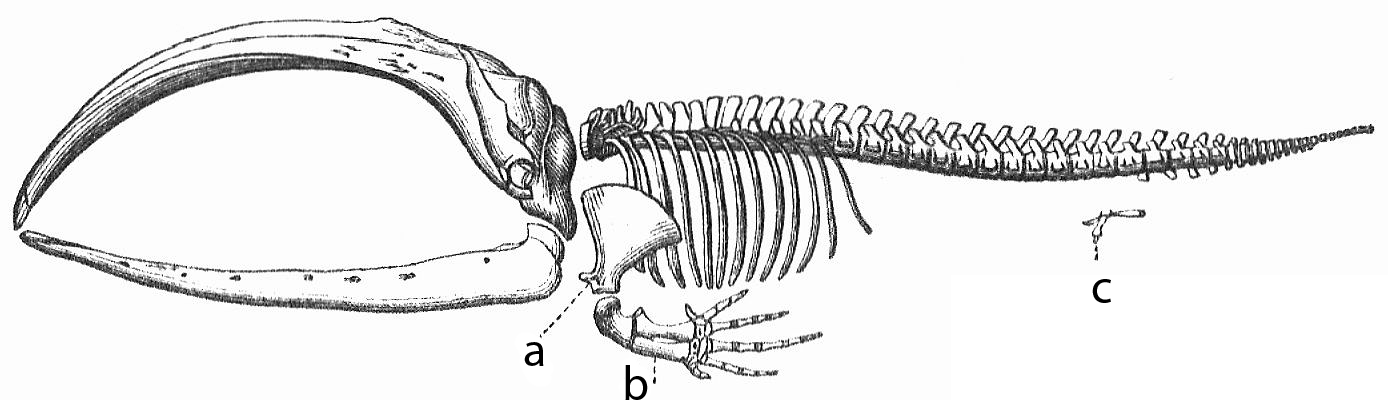
Image link: Image result for whale bones

Summary: This week we learned about how scientists find the common ancestor of an organism. There's actually multiple ways such as comparative anatomy and a cladogram. Comparative anatomy is when scientists check the bones of an organism and compare it to the bones of another organism. If they have a similar bone structure or they have a bone that's the same then they could both have come from the same common ancestor. A cladogram is similar except it doesn't just to bones it also does hair and embryos. A cladogram is similar to a graph and a scientist would use this to compare traits of multiple organisms and would see which organisms were most related.

SP4: Analyzing and interpreting data
Scientific investigations produce data that must be analyzed in order to derive meaning.

Did you create a graph, table, drawing, etc. of the data you obtained in an experiment?

Yes because we used a cladogram to see who was most related to a T-rex and we used a graph to record our data.

Sunday, October 29, 2017

Weekly blog 10/29/17

Image: Image result for peppered moths

Summary: This week I learned about peppered moths, their different colors, how they can survive, and how their population decreased. I learned that peppered moths can come in different colors such as the normal color which is white with black spots or just a dark colors. The peppered moths live in trees with a type of fungi in them and depending on the color of the trees the moths can survive or get eaten by predators. If the tree is a light color then the light colored moth would be able to survive better than the dark colored moth. But if the tree becomes a darker shade then the dark colored moth would be able to survive better. Peppered moths can also survive in the winter because their larvae turn into pupae during the winter so that they stay warm. I've learned that the peppered moths are a form of natural selection because nature can choose whether or not they're a dark colored moth or light colored moth depending on their environment or depending on whether or not it'll help the moths survive.

SP4: Analyzing and interpreting data
Scientific investigations produce data that must be analyzed in order to derive meaning.

Did you create a graph, table, drawing, etc. of the data you obtained in an experiment?

Yes in class we played a game where you were a bird and you chose an area where you had to eat as many moths as you could within the time limit. On a google doc though there was data already recorded but you needed to put all that information in a graph. There was 2 sets of data. One for the light forest and one for the dark forest. When you put them in the graphs you had to answer questions while looking at the graph.

Friday, October 20, 2017

Weekly blog 10/20/17

Image: Image result for natural selection


Summary: This week we learned about natural selection and we did an experiment. I understand natural selection more clearly now that we did an experiment about it. Natural selection is when nature selects traits that will help a population of animals survive from predators or the environment. An example is if a species is living in the desert and a trait that they get from natural selection is less fur so that the species doesn't get overheated. I also learned that through natural selection a lot of species of animals and insects are able to survive.

SP3: Planning and carrying out investigations
A major practice of scientists is planning and carrying out systematic investigations that require clarifying what counts as data and in experiments identifying variables.

Did you plan and carry out an investigation?

(Mostly when we do a investigation, lab, or experiment)

Yes we did an experiment about natural selection that included spoons, knifes, and forks. The spoons, knifes, and forks represented species of animals. There was also seeds and buttons that represented a food source for the species of animals. The experiment was that 1 person would be a spoon, a knife, or a fork. At the same time everyone would try to get as much 'food'as they possibly could with their 'species'. This experiment helped me understand natural selection by showing how certain traits in species help them get food. Such as the spoon and fork getting the most food because they both have traits to help them pick up more food. The knife however became extinct since it doesn't have a trait that helps it pick up food. This is like how lions have sharp teeth and claws to hunt down prey but giraffes have long necks to get leaves from high trees for food.

Sunday, October 15, 2017

Weekly blog 10/15/17

Image: Image result for gene flow
Image link: https://commons.wikimedia.org/wiki/File:Gene_flow.jpg

Summary: This week I learned about gene flow, genetic mutation, natural selection, and genetic drift. I researched gene flow while my team mates researched the the other subjects. Gene flow is when one species moves to a different species when neither of the species have interacted before. Genetic mutation is when someone's DNA changes permanently and it's totally random. The mutation can either be useful or not to survival. Natural selection is when the more common genetic trait is shown such as if a brown beetle were to reproduce with another brown beetle then their children would be brown beetles. Lastly genetic drift is when some genes of an organism is missing and the organism doesn't have that gene. An example is if someone is double jointed and their child isn't double jointed.

SP3: Planning and carrying out investigations
A major practice of scientists is planning and carrying out systematic investigations that require clarifying what counts as data and in experiments identifying variables.

Did you plan and carry out an investigation?

(Mostly when we do a investigation, lab, or experiment)

Yes we did 2 experiments in class, one was about genetic drift and the other was genetic mutation. The experiments included using M&M's and tic tacs.

Saturday, October 7, 2017

Project blog geologic time 10/7/17

Image: Image result for geologic time scale


Summary: The project that we did was based on the following eras, the Precambrian era, the Paleozoic era, the Mesozoic era, and the Cenozoic era. The Precambrian era was the beginning of the earth and it looked like it was the apocalypse. The Paleozoic had the 2 snowball earths which covered the earth in ice. The Mesozoic era was the era of dinosaurs and the start of flowers. Lastly the Cenozoic era was the start of humans which then leads us the modern age. The era I studied though was the Mesozoic era which also had some extinctions. These extinctions happened during the Jurassic period one of which affected 80% of marine bivalve species. The second affected many creatures but 2 species didn't make it to the Cretaceous period.

Backward-Looking: How much did you know about the subject before you started?
I didn't really know anything about the subject except that it was about the dinosaurs and how they became extinct. I even thought that the only thing it was about was the dinosaurs. I also didn't know that they had periods for each era or that it during this time it had 4 eras. I didn't even know that archeologists used certain tools to find how old bones are based on the rocks. The only other thing that I knew though was that it was the beginning of the earth and life on earth.

Inward-Looking: What did/do find frustrating about it?
What I found frustrating during the project process was that the title was a bit messy but I got over it quickly. What I also saw frustrating was that my teammates had weren't working the whole time so we had to meet up to work on the project. We also painted on small mini earths but one of my teammates glued the earth onto the tri fold. The earth was dry but the team mate doing that earth painted it again so we had a bit of trouble dealing with a wet earth on the tri fold. What I still find frustrating is that there was a mess up on one of the era names so we needed to use white out. I still find it frustrating because it bothers me that it looks different with the white out.

Outward-Looking: What grade would you give it?Why?
For organization I would give the project a B+, for information I would give the project an A, and for creativity I would give it an A. I would give organization a B+ because some text from one era and another era would look like they're a connecting sentence. Then I would give information an A because the information is good and it has pictures that relates to the information. Lastly I would give creativity an A because we used arrows and we also put mini earths on our tri fold. Another reason is because we were one of the only ones that used a tri fold.

Forward-Looking: What would you change in the next revision of this piece?
A few things that I would change in the next revision of this piece is the title, the way that the text is kind of slanted in the Mesozoic era, and fix the paint stains on the paper. I would want to fix the title because it looks a bit messy and the top is kind of ripped. I would also want to fix the text because since it's slanted it's leaning toward the era on it's left. Lastly I would want to get rid of the paint stains because the paint stains are noticeable even though we put white paint over it. The paper on the tri fold is also a bit crinkled. I'd want to make sure that the paper isn't crinkled in the next revision as well.

Tuesday, September 19, 2017

Era report WAC

   My era is the Mesozoic era when dinosaurs ruled the earth. The reason why it's called the Mesozoic era is because Mesozoic means middle animals. The Mesozoic era is separated into three different periods which is the Cretaceous period, the Jurassic period, and the Triassic period. The two continents Europe and Asia both slammed into North America and Pangaea was formed. Pangaea is a super continent that soon drifted apart which formed Laurasia and Gondwana. The rest of the continents started to drift apart (continental drift) and they kind of had the look of what the earth is today.

   In the Mesozoic era besides dinosaurs and other animals, there was plants. Some plants that existed during the Mesozoic era was ferns, gymnosperms, and flowering plants. Ferns are plants that appeared after the Permian extinction along with gymnosperms. Gymnosperms are plants that had very good reproductive systems. Their reproductive systems were good because their seeds and pollen could go through a drought and then grow into the infant plant. Then the flowered plants entered in the Cretaceous period attracted many insects such as butterflies, ants, termites, and bees. In return the insects would spread the pollen to other plants. The flowered plants appeared on the trees such as maple trees and magnolia trees.

   Animals in the Mesozoic era included dinosaurs, small mammals, amphibians, and some sea creatures. Some dinosaurs in the Mesozoic era is the Apatosaurus and the Brachiosaurus which lived in the Jurassic period. There was also a small lizard like creature that was alive. They were called Diapsids and you could recognize them by their holes on their heads just behind the eyes. There are also the small sea creatures which is fish, corals, and Mollusks. Besides the sea creatures, some lizards started to be able to breath in the water and on land. This caused them to become the top of the food chain in the Mesozoic era.

   The climate in the Mesozoic era was tropical and it had a higher temperature than the Paleozoic era. In the Mesozoic era, there was also more deserts and less swamps since it was also dryer in the Mesozoic era than the, Paleozoic. Other than climate though there was also some important events, such as the Triassic extinction and 2 extinctions in the Jurassic period. During theTriassic extinction the creatures that became extinct was the labyrinthodont amphibians, conodonts, and all marine reptiles (the reptiles that could breath in water and land). Then in the Jurassic period the first extinction happened. Shallow water species and 80% of marine bivalve species went extinct during this time. Lastly the 2nd extinction happened near the end of the Jurassic period and some species severely affected by this, was the ammonoids, marine, reptiles, and bivavles, There was also some dinosaurs that were affected by this such as the stegosaurus and most sauropods. These dinosaurs didn't make it to the Cretaceous period.

   In conclusion there were some important events and some non important events that happened during this era. There were different plants and a variety of animals, some lived and some didn't. Some animals may have even only been alive in one period. But some I think evolved and survived to our modern world, or they might have just stayed the same and still survived. There may even be some animals that we didn't know existed in the Mesozoic era.